Posts

Showing posts with the label adnd

Dan’s Top 19 RPGs - #7 - Advanced Dungeons & Dragons

Image
 This was one of the tougher games for me to place. For a long time, Advanced Dungeons & Dragons was the main game I played. I’m going to commit some old-school heresy and link the first and second editions of the games together - though there certainly was some stylistic changes, AD&D 2nd edition was more a change along the lines of editions of Call of Cthulhu than the leap between AD&D and Dungeons & Dragons 3rd edition. One could even make the argument of linking AD&D and B/X D&D but given the number of differing assumptions between the two parallel game lines, I’ve chosen not to do that - though truth to tell, my groups, like most, happily cross-pollinated between the two lines - but we usually preferred AD&D. What was it about AD&D? I think what I liked about it was that it was a dense game. The early books were tomes you could explore. It was a crunchy game - not   Aftermath crunchy but compared to B/X D&D there was a lot to the ...

Saltmarsh in Hyperborea

Image
In our Hyperborean campaign I've been adapting the AD&D 1st edition Saltmarsh series for Astonishing Swordsmen & Sorcerers of Hyperborea . There's spoilers here for the entire series so if you're unfamiliar with the adventures and have reason to want to stay that way, you might want to hold off reading. Alrighty... So the Saltmarsh series is marked by a series of discoveries: A "haunted" house is being used by smugglers. Those smugglers have been selling weapons to a group of lizard men alarmingly close to Saltmarsh.  The lizard men were kicked out of their original lair by sahuagin. Who also pose a threat to Saltmarsh... The lizard men have been assembling an alliance of aquatic folk against the sahuagin. So how does this fit in Hyperborea? With its long winters, Hyperborea is a horrible place for cold blooded creatures like the lizard men. I posit they must go into a long torpor as their swamps freeze over.  In the current 13-year c...

On the Use of Henchmen in OSR Games

Image
When I first starting playing D&D in the 1980s, Charisma was the most common dump stat. We pretty much ignored the rules on hirelings and henchmen. From what I've read online, our experience was not unique. However, I've also seen for many groups henchmen were an important component of the early game and the 1st edition Dungeon Masters Guide bears this out, with considerable space dedicated to the acquisition and loyalty of henchmen. In our AS&SH game, one of the players had two characters, both of whom had high Charisma scores. He decided to use some of his starting cash to hire some mercenaries. It wound up being an extremely good investment - giving the party additional firepower while at the same time giving the monsters additional targets to aim for. I suspect should the henchmen survive up to the point where the characters make it to second level, I might allow the henchmen to gain a little bit of experience and reach 1st level, with an eye towards al...

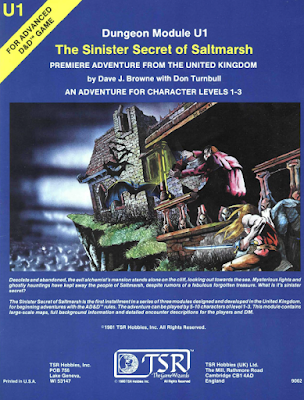
RPG Review: The Sinister Secret of Saltmarsh

Image
We're currently working our way through The Sinister Secret of Saltmarsh in our AS&SH game. It adapts pretty well and at a later point I might write up about adapting the series. This post however is simply a brief review of the adventure itself. If you're in my group it's probably best to hold off in reading this until we're done, though I'd not be surprised if some or all of you have played or run this in the past, as it is a fairly common adventure from the 1st edition... The Sinister Secret of Saltmarsh  is an adventure from the UK branch of TSR, copyrighted to 1981. It has a bit of a different feel from most adventures of the period. It has a bit of a heavier plot than most adventures back then - it's not like later adventures which sometimes go so far as to render player decisions moot. Rather it has a set of NPCs with their own agenda who aren't likely to sit waiting for the PCs to arrive. Saltmarsh is a two-part adventure as well as being ...

#RPGaDay 2017 Day 12 - RPG With Most Inspiring Interior Art

Image
This is more of a "show, don't tell". For me, the 1st edition Dungeon Masters Guide  has the most inspiring interior art. From dramatic to goofy it sets the stage for an AD&D game. An almost-but-not-quite medieval society, with the influence of magic and monsters clearly evident.

#RPGaDay 2017 Day 5 - Which RPG Cover Best Captures the Spirit of Its Game

Image
For me the RPG cover that best capture the spirit of its game is from the game that got me into the hobby - the Erol Otus D&D Basic Set cover. The treasure. The weird environment. The bold adventurers. And the dragon emerging from the water. It was very clear what the game was all about.  I've two close runner-ups. The first is the first edition AD&D Players Handbook . Like the Otus drawing above, it captures what the game is all about. These aren't necessarily heroes, they're after the gemstone eyes. Finally, Call of Cthulhu has had some great art. My own favorite is the cover to the third edition.We've got a mysterious castle/house the investigators are approaching. These aren't hardened warriors. Even without the slithering horror it's a creepy scene, full of menace.

Thoughts on Lankhmar as a Campaign Setting

Image
I first encountered Fritz Leiber's Lankhmar in the 1980s in the pages of TSR's Deities & Demigods book for AD&D followed by their Lankhmar: City of Adventure sourcebook. I had a pretty difficult time finding collections of Leiber's stories - my recollection is they either were out of print or not at my local Waldenbooks, in these days before Amazon. It was shortly after I graduated college that White Wolf released a series of hardcovers compilations that I finally managed to read all of the stories - and it's been an awfully long time, it might be time for a reread. Lankhmar has found its way into a number of RPG properties. TSR released a number of Lankhnar products - AD&D wasn't a horrible match for the setting but I feel it needed a bit more tweaking than they gave it. Mongoose Publishing did two versions of Lankhmar for RuneQuest but to be honest, I was less than impressed by those efforts, though I think RuneQuest is a very good match for the s...

Remembering Role Aids

Image
One of my more humorous moments explaining a gaming book occurred in the mid-1980s. I was in the back seat of my grandfather's car flipping through Role Aids ' Elves  book while we were stuck in traffic on Ocean Parkway in Brooklyn. My grandmother asked what I was reading and I showed her the book. She misunderstood the title and thought I was reading a book about Elvis, not Elves. To this day when I look at the cover of that book I keep thinking it does kinda look like he's getting ready to rock... Since the 3rd edition of D&D Wizards of the Coast has embraced third party adventures, though they were perhaps a bit less receptive in the 4th edition era. They had made the discovery they made their most money on books that everybody bought - rulebooks and supplements. Adventures might be needed but they didn't make nearly as much money. Prior to that, the original owners of D&D, TSR, was rather draconian about allowing 3rd party products. They did lic...

Understanding Bell Curves at Age 11 - Math from D&D

Image
I'd planned on writing some more about Call of Cthulhu  this evening but a combination of family and homework have occupied my evening and necessitate a bit of a brief post tonight. And it's homework that got me thinking about statistics and RPGs. Currently I'm taking a Statistics class as part of my Strategic Analytics Master's program at Brandeis University. I'm diving deep into data science. My current statistics course is less focused with performing various statistical operations (though that is part of it) but rather with how best to present them.  The diagram I show above is a simple comparison of a bell curve and a linear distribution from the 1st edition of the AD&D Dungeon Masters Guide.  I seem to recall picking it up in 5th grade or maybe the summer before 6th grade. And the curve was a bit of a mystery to me. It seems obvious now, but a probability curve was some heavy math for an 11-year old. After some heavy duty analysis (for an 11-y...

#RPGaDay2015 Day 15 - Longest Campaign Played

Image
The next campaign is always the best one. Some of us, like yours truly, are easily distracted by shiny things. I'm rather pleased that my recent Dungeon Crawl Classics "campaign" ran to completion with a total party kill in its second adventure... My longest overall campaign is probably a game my brother and I would do off and on throughout the late 80s to the mid 90s, working its way through a variety of classic AD&D adventures along with a number of home-brew adventures. The Temple of Elemental Evil fell, the Slave Lords were defeated, as was Lolth, Demon Queen of Spiders. Great times were had on the Isle of the Ape as well as a visit to modern (1980s) London to retrieve the Mace of St. Cuthbert. In a more traditional group I'd say the longest game I played in was a Star Wars campaign I ran from 1999 through 2004, with a few breaks for some Star Trek and D&D 3rd edition. It was a Rebellion campaign, starting off with a Jedi in Training former Imperial ...

#RPGaDay2015 Day 12 - Favorite RPG Illustration

Image
I'm actually able to give a straight answer on this one as I do have an actual favorite - it's a classic and one I'm sure others will have it as well and deservedly so - David Sutherland's A Paladin in Hell from the 1st edition of the AD&D Players Handbook. For me this illustration captures the heroism of the paladin - not the infamous "lawful stupid" caricature but the true hero who will fight the forces of evil in their own domain against overwhelming odds. I'd also like to highlight the work of Tim Bradstreet who became best known for his work on Vampire: The Masquerade.  Another of my all-time favorites is his "Methusalah" illustration from that game's 1st edition: It would be hard to overstate the impact Vampire had on the gaming community in the 1990s. A large part of this was its extremely evocative art. I tried to picture one piece of Tim Bradstreet's art which really captured the moment,

RPG Review: The Ghost Tower of Inverness

Image
For whatever reason, I don't think I played C2: The Ghost Tower of Inverness  more than once or twice. Part of the reason, now that I think of it, is my grandmother needed the picture of the seer within it as a model for the Halloween costume she sewed for me - my grandmother was quite the seamstress but not particularly familiar with the fantasy genre. The Ghost Tower of the title refers to the central tower of the castle of the dreaded wizard Galap-Driedel. The entire  Castle Inverness was magically lifted "from the very foundations of rock upon which it rested." Within the central tower was said to be the "Soul-Gem" which "dragged the souls of men screaming from their mortal flesh and trapped them within its many facets." When one day the wizard failed to return an angry mob (presumably with pitchforks and torches) stormed the castle and tore down the central tower. Though on fog-shrouded nights the central tower can supposedly still be seen (a ...

Story-Based Adventures

Image
Both my current and immediately previous campaigns could be considered "old school" campaigns. Right now I'm playing Dungeon Crawl Classics and my previous campaign was of Call of Cthulhu, something of a living fossil in that despite being in its 6th edition it is very close to the game it was when it started. Despite this I don't necessarily consider myself to be an old school player and this blog has discussed newer games in addition to the older ones. I've enjoyed both flavors. Reflecting on this has made me think of the transition from old school to new school gaming. In the 70s and early 80s most adventures, at least for D&D, had the slimmest of plots. There was typically a dungeon and sometimes there was a bit of a plot and reason for you to go there but these were usually easily changed. In his Grognardia blog, James Maliszewski has referred to this transition as the Hickman Revolution. Tracy Hickman wrote the Desert of Desolation series of advent...

AD&D Reprints First Impressions

Image
The reprints for the AD&D 1st edition rulebooks arrived at my house on Friday from Noble Knight Games. If my memory serves, this is not actually the first time the original AD&D books have been reprinted - I seem to recall an Italian publisher got permission to reprint the books in an extremely tiny format back in the late 90s - I remember seeing them at Cambridge's Pandemonium Books & Games. They were more a curiosity, with each page being condensed to something around the size of a playing card. I didn't pick them up and to be honest it's not something I regret not getting. These newest reprints are designed to be more useful, being back to the original size. I've read on Wizards of the Coast's website that a lot of work went into the reprints - there were no digital files beyond basic scans so apparently each page had to be redone. The effort seems to have been successful - comparing them with my original AD&D books you really can't see ...

Clerics, Blunt Weapons, and Christian Assumptions

Image
One of the neat things about digging up many of pre-1970s works that inspired D&D is finding the origins of some of D&D's concepts and rules. One items which received a lot of humor back in its day was the restriction of clerics only being able to use blunt weapons as they were forbidden from using weapons which shed blood. Anyone who has seen a medieval mace knows that a solid hit with one of those is going to shed a lot of blood, blunt weapon or not. Recently I was reading Barbara Tuchman's A Distant Mirror: The Calamitous 14th Century . It included the following statement: [The knight] also had available, either attached tio his saddle or carried by his squire, a longer sword for thrusting like a lance, a battle-ax fitted with a spike behind the curving blade, and a club-headed mace with sharpened, ridged edges, a weapon favored by martial bishops and abbots on the theory it did not come under the rule forbidding clerics "to smite with the edge of the ...

RPG Review: The Rogues Gallery

Image
The D&D Basic Set had a spell known as "Floating Disk". It created a magical platform that would follow you around. Obviously its purpose was to provide a way to carry loot out of the dungeon - though you have to pity the poor magic-user who had that as his only spell. Congratulations, you studied magic for all those years to become a pack horse for a barbarian warrior! When I purchased the AD&D Players Handbook  thinks changed. The Floating Disk spell was changed. Now it was "Tenser's Floating Disk". And this wasn't the only named spell - you got all sorts of spells from the wizard Bigby to allow the creation of grasping hands, crushing hands, clenched fists, etc. There were spell immunity spells from Serten. It gave a glimpse of a game that was played by real people. Reading articles from The Best of Dragon Vol. 1  (which I encountered at a Brooklyn bookstore where I also purchased The Fellowship of the Ring ) I got more glimpses of Gary Gygax...

RPG Review: Expedition to Barrier Peaks

Image
Having just seen Prometheus  this weekend science-fiction is a bit on my mind right now. This has me thinking about one of the odder 1st edition AD&D adventures, Expedition to Barrier Peaks . Expedition to Barrier Peaks  was, according to its preface, written for the Origins II convention as a way to introduce players to Metamorphosis Alpha , the 1970s TSR RPG about the inhabitants of a lost generation ship (who are no longer aware they are on a ship). In this adventure a space colonization expedition was struck by a plague. Attempting to stop the spread of the plague the components of the ship separated and went their separate ways. The one the adventure takes place on found its way through a black hole to the World of Greyhawk (obviously one could move it to another fantasy setting). Per the story worker robots cleared the cargo hatch and released various alien fauna, some of which prospered (providing an interesting explanation for some of the odder D&D monsters...

Speed Factors and Weapons vs. Armor

Image
Back in the 80s my gaming group quickly "graduated" from D&D to AD&D. Though it sure would have been nice if TSR could have gotten out The Temple of Elemental Evil  a bit faster. In 1st edition AD&D I recall there were two rules we pretty much totally ignored (well there were probably more than two...) These were rules for weapon speed factor and for weapons getting different bonuses and penalties vs. different types of armor. These were decent ideas in theory but in practice we really could not makes heads or tails of the rules. That's not entirely true - we couldn't make heads or tails of the speed factor rules. With that in mind let's start with Weapons vs. Armor. This one is simply enough to understand. Any given weapon is more effective against some armors than others. This makes sense. Consider the medieval knight. He did not go around with a single weapon. At the very least he had his lance, mace, and sword. (As an aside, raise your ha...

Player vs. Character Abilities

Image
On a recent Google+ conversation I found myself discussing what makes an "old school" D&D game. Part of the conversation involved whether throttling back character abilities is what makes something old school. For example, in AD&D your magic-user can cast a single 1st level spell once per day at first level. He might have as few as 1 hit point and can wear no armor nor master the weapons of a fighter. In the 3rd edition of D&D your 1st level wizard may have multiple spells per day with high intelligence, is guaranteed to start off with at least 4 hit points (barring low constitution), can wear armor if he wants to risk spell failure, can learn how to use fighter weapons, etc. Moving on to 4th edition this wizard at 1st level now has an unlimited amount of magic missiles available to him. Clearly character abilities, especially at low levels, is something that has increased with newer editions of the game. I'd argue that is certainly part of what one finds in...